

My son looked me in the eye at his wedding and said I was not invited. I smiled, said, “I understand perfectly,” and walked out. Then, somewhere between the vows and the champagne, his phone started vibrating inside his tux.
I gave my name to the young woman at the reception table and watched her check the guest list twice, then once more like she hoped I might appear if she looked hard enough.
Then she lifted her eyes and gave me that careful event smile.
“I’m sorry, ma’am. Your name isn’t here.”
For a second, I just stood there with my silver clutch in both hands, violin music drifting out from the ballroom behind her, trying not to let my face show what my chest already knew.
“I’m Ethan’s mother,” I said. “There has to be a mistake.”
That was when I saw him crossing the lobby in a black tuxedo, adjusting his cuff links like I was an inconvenience that had arrived ten minutes too early.
“Mom,” he said quietly, “what are you doing here?”
“My name isn’t on the list.”
He barely glanced at the table.
“It’s not a mistake.”
I remember the exact way those four words landed. Clean. Flat. Practiced.
“I told you,” he said. “We wanted the wedding small. Close family only.”
I looked at him and said the only thing that mattered.
“I am your family.”
He rolled his eyes.
“Did you really think you’d be invited after everything you’ve done?”
Before I could answer, Brooke stepped up beside him in white satin and pearls, all polished edges and perfect posture. She looked me over the way people inspect something that does not belong in the room.
“What is she doing here?” she asked.
“She’s leaving,” Ethan said.
There are moments when your heart breaks loudly. And there are moments when it breaks so quietly nobody notices but you.
That was one of them.
I could have argued. I could have cried. I could have reminded him who sat beside hospital beds, who worked double shifts, who stretched one paycheck across school tuition, braces, rent, gas, and every emergency a child can bring.
Instead, I smiled.
“I understand perfectly,” I said. “Have a beautiful wedding.”
Then I turned and walked past the flower stands, past the valet podium, past the glass doors, and into the cold evening air.
My name is Clara. I’m seventy-one years old. I adopted Ethan when he was three, when he was a frightened little boy with a broken toy truck and no reason yet to believe anybody stayed. I gave him my name, my home, my years, and every ounce of steadiness I had.
Love does not always fail in one loud moment. Sometimes it is erased politely, one small permission at a time.
Brooke had been working on that erasure from the beginning.
A smile over dinner when she called my food too salty.
A soft laugh when she asked if my blouse was “a little young” for me.
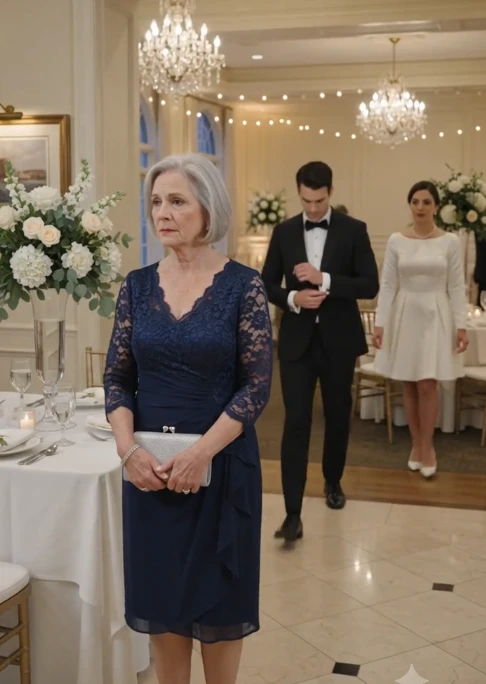
The first vibration came while Ethan was standing beside his new wife beneath an arch of white roses.
The second came before the photographer finished arranging Brooke’s train.
I know because he told me later.
What he did not tell me was which notification he opened first.
The email from my attorney.
The alert from First Meridian Bank.
Or the message from the title company informing him that the scheduled transfer attached to his new home purchase had been placed on immediate hold.
At 9:17 that evening, my phone rang.
I was sitting at my kitchen table with a cup of tea I had forgotten to drink.
For thirty-eight years, I had taken tea at nine whenever I was home. Ethan used to tease me about it.
“Even the Queen takes nights off, Mom.”
That night, I boiled the water.
I warmed the cup.
I added lemon.
Then I sat there while the steam disappeared.
His name glowed on the screen.
ETHAN.
I let it ring six times.
Then I answered.
“Hello.”
“What did you do?”
No hello.
No Mom.
No question about whether I had gotten home safely.
I looked at the folder lying open beside my untouched tea.
“I came home.”
“You know what I mean.”
Behind him, I could hear music.
Glasses clinking.
Someone laughing.
His wedding was still happening.
“Then say what you mean, Ethan.”
Silence.
It was a small thing, but I heard the change immediately.
He had expected the woman from the lobby.
The woman who would explain herself.
The woman who would search for some softer interpretation of what he had done.
I had spent three days doing exactly that.
Maybe Brooke was overwhelmed.
Maybe the guest list really was small.
Maybe Ethan was under pressure.
Maybe he would see me and remember.
There is a particular cruelty in denial.
It lets you keep the person you love for a few extra hours, but only by pretending you did not hear what they said.
“Daniel Mercer emailed me,” Ethan said. “He said you revoked something.”
“Several things.”
His breathing changed.
“What several things?”
I picked up my tea.
It had gone cold.
“The financial power of attorney you’ve held since my surgery six years ago.”
“That was for emergencies.”
“Yes.”
“I never used it.”
I looked at the folder.
There were three pages clipped beneath Daniel’s letter.
“Then revoking it should not inconvenience you.”
Another pause.
Longer this time.
“Mom.”
There it was.
Not affection.
Strategy.
I closed my eyes.
For one second, I saw him at five years old standing on a kitchen chair beside me, flour on his cheeks, trying to cut Christmas cookies with the wrong side of the cutter.
He had called me Mommy every thirty seconds that year, as though he feared the word might disappear if he did not keep using it.
I opened my eyes.
“What else?” he asked.
“The beneficiary instructions on my investment accounts.”
The music behind him seemed to recede.
“And?”
“My trust.”
“What about it?”
“I amended it.”
His voice sharpened.
“Tonight?”
“Yes.”
“You changed your will because I asked you to leave a wedding?”
“No.”
I set the cup down carefully.
“I changed my estate because tonight clarified something I have been refusing to understand for several years.”
“That’s insane.”
“Perhaps.”
“You’re punishing me.”
“I’m protecting myself.”
“From your son?”
The question came fast.
Almost offended.
I stared at the word SON printed on an old emergency contact form inside the drawer beside me.
For years, that word had been enough.
Enough reason to trust.
Enough reason to overlook.
Enough reason to leave doors unlocked that I would never have left open for anyone else.
“Yes,” I said.
That was the first time he stopped speaking entirely.
I heard someone near him ask if everything was all right.
Brooke, probably.
Then his voice dropped.
“You need to undo this.”
It was so calm that I almost laughed.
Not because anything was funny.
Because he had said it the way he used to tell me the cable box needed resetting.
A small problem.
A mother problem.
Something I would fix.
“No.”
“Mom, listen to me.”
“I am listening.”
“We have financial commitments.”
I looked at the folder again.
That sentence mattered.
Not because of what he said.
Because of what he did not.
“What commitments?”
“It’s our wedding night.”
“That was not my question.”
“We can talk tomorrow.”
“No. You called me tonight.”
His voice lowered further.
“Brooke and I are closing on the Oakridge house Monday.”
I knew about Oakridge.
A six-bedroom stone house thirty minutes outside the city.
Brooke had shown me photographs once over lunch.
She had called the kitchen “small” even though it had two ovens.
I remembered joking that I had raised Ethan in a house whose entire first floor could fit inside that kitchen.
Neither of them laughed.
“I know,” I said.
“The bank is saying the gift funds are frozen.”
Gift funds.
I leaned back in my chair.
“How much?”
He hesitated.
That hesitation told me he knew the number perfectly.
“Mom.”
“How much?”
“Two hundred and forty thousand.”
There are betrayals so large the mind refuses to hold them all at once.
It breaks them into smaller pieces.
Two.
Hundred.
Forty.
Thousand.
I touched the edge of the table with my fingertips.
“When did I give you two hundred and forty thousand dollars?”
“It wasn’t like that.”
“What was it like?”
“You always said you wanted to help me buy a home.”
“I said I wanted to help you with a down payment.”
“That is a down payment.”
“No, Ethan. That is more than I paid for my first house.”
“You can afford it.”
The words came out before he could stop them.
There it was.
Not need.
Not gratitude.
Arithmetic.
I looked toward the dark window above the sink.
My own reflection looked back at me.
Seventy-one.
Hair I had carefully curled for a wedding I was not allowed to attend.
Pearls still around my neck.
For some reason, I reached up and removed them.
One by one, I worked the clasp loose.
Then I laid them beside the folder.
“If I can afford something,” I said, “that does not make it yours.”
“That isn’t what I meant.”
“It is exactly what you meant.”
“Brooke’s family already knows about the house.”
I almost missed it.
Not the house.
Brooke’s family.
The image.
Again.
“What do they know?”
“That we’re closing Monday.”
“Do they know where the money is coming from?”
Silence.
I waited.
Silence does extraordinary work when you stop rescuing people from it.
Finally he said, “They think we arranged it.”
“You did arrange it.”
“You know what I mean.”
“I’m beginning to.”
He exhaled hard.
“Mom, please don’t do this tonight.”
“Tonight seems to be when this family makes important decisions without discussing them with me.”
“That’s not fair.”
I almost admired the sentence.
Not fair.
At seventy-one years old, after being removed from my son’s wedding guest list, I was being told fairness required me to release nearly a quarter of a million dollars because his in-laws had expectations.
I opened the top page Daniel had sent.
“Ethan, I’m going to give you one opportunity.”
His breathing stopped.
“If you tell me the truth right now, I will listen before I make any further decisions.”
“I am telling you the truth.”
“No. You are telling me what you think will preserve the outcome you want.”
“Mom—”
“Did you instruct anyone to transfer money from my investment account?”
“No.”
I looked down.
“Did Brooke?”
“I don’t know.”
“Did either of you submit documents representing that I intended to give you two hundred and forty thousand dollars?”
Nothing.
The silence changed shape.
I could almost see him standing there among the flowers and champagne, one hand over his other ear to block the music.
“Where are you getting this?”
“Answer me.”
“It’s complicated.”
“No. Complicated is whether people should stay married after they stop loving each other. A signature is either mine or it is not.”
He said nothing.
I heard Brooke’s voice more clearly now.
“Ethan?”
He must have turned away from her.
Then he said, “There was paperwork.”
“What paperwork?”
“A gift letter.”
I closed my eyes.
Daniel had used the same phrase.
Gift letter.
The bank required one to prove that money used for the house would not need to be repaid.
“Did I sign it?”
“You had already told me you wanted to help.”
“That is not what I asked.”
“You’re twisting this.”
I stood so suddenly my chair scraped against the floor.
I did not shout.
That surprised even me.
I walked to the sink, lifted the cold tea, and poured it down the drain.
Then I washed the cup.
One slow circle with the sponge.
Rinse.
Dry.
Return it to the cabinet.
I needed one ordinary thing to remain ordinary.
“Ethan.”
“What?”
“Did I sign the gift letter?”
He whispered something I could not hear.
“Say it again.”
“No.”
The kitchen became very quiet.
I rested both hands on the counter.
“Then whose signature is on it?”
“Mom, before you react—”
“I am not reacting.”
My voice was so calm it frightened him more than anger would have.
“I am asking.”
“Brooke handled most of the mortgage documents.”
I stared at the black window.
“So Brooke forged my signature?”
“I didn’t say that.”
“You just told me I did not sign it.”
“I’m saying there may have been a misunderstanding.”
I almost corrected him.
Almost said forgery is not a misunderstanding.
But denial is stubborn.
Even after the truth enters the room, part of you keeps offering it a coat and asking whether perhaps it has come to the wrong house.
I wanted there to be another explanation.
A clerical error.
An electronic consent.
A conversation I had forgotten.
Anything that let Ethan remain merely weak instead of dishonest.
“Put Brooke on the phone.”
“What?”
“Put your wife on the phone.”
“This is our wedding.”
“Yes.”
“You want to interrogate her on our wedding night?”
“No.”
I looked at the pearls beside the legal folder.
“I want to know whether my son is lying to protect his wife or whether he is lying to protect himself.”
He went silent again.
That silence answered more than I wanted it to.
Finally he said, “We’ll come over tomorrow.”
“No.”
“Mom.”
“You are not coming to my house tomorrow.”
“What are you talking about?”
“I am establishing one very simple boundary. Until Daniel has reviewed every document connected to my accounts, neither you nor Brooke will enter this house.”
“You’re locking me out?”
“You removed me from a ballroom, Ethan.”
My fingers tightened against the counter.
“I am removing you from my finances.”
“That is not the same thing.”
“No,” I said softly. “It is not.”
He started talking faster then.
About timing.
About the mortgage.
About deposits.
About how embarrassing it would be if the closing failed.
He told me Brooke’s parents had already invited relatives for a housewarming.
He told me furniture was being delivered Tuesday.
He told me cancelling now could cost them earnest money.
Every sentence made the truth more visible.
Not once did he ask whether I was frightened.
Not once did he ask whether someone had used my name illegally.
He only described what my refusal would cost him.
When he finally stopped, I said, “You should go back to your wedding.”
“How can I?”
That sentence nearly broke something open inside me.
Because for one foolish instant, I wanted to say I was sorry.
I wanted to tell him I would fix it tomorrow.
I wanted to give him one more night where the world worked the way he expected because his mother absorbed the damage.
That was bargaining.
Not with him.
With the past.
If I saved tonight, perhaps I could pretend there was still something left to save.
My voice softened.
“Tell me the complete truth tomorrow morning, Ethan. No omissions. No Brooke said. No misunderstandings. If you do that, I will hear you before I decide what happens next.”
He seized on it immediately.
“So you’ll release the money?”
“I did not say that.”
“But you’ll reconsider?”
“I said I will hear you.”
“That’s not enough.”
There it was again.
I closed my eyes.
“No,” I said. “Apparently it never was.”
I ended the call.
For almost a minute, I stood in the kitchen holding the phone.
Then it rang again.
Brooke.
I declined it.
A text arrived.
You are destroying your son’s wedding because your feelings were hurt.
Another.
This is exactly why Ethan needed boundaries.
Then a third.
You promised him that money.
I read that one twice.
Not because I believed her.
Because of one word.
Promised.
I opened Daniel’s folder.
The document I had removed from the drawer earlier was underneath it.
A copy of the Clara M. Reeves Revocable Trust.
Created nineteen years ago.
Amended twice.
Ethan had never read it.
He only knew I had “taken care of things.”
Until that night, he had been the sole beneficiary of nearly everything I owned.
My house.
My investment accounts.
A small commercial property I had inherited from my father.
The trust had never made him wealthy while I lived.
But eventually, if nothing changed, it would have made him a very wealthy man.
He apparently believed eventually had already begun.
At 10:43, Daniel called.
“Clara.”
“I’m here.”
“We found the gift letter.”
I sat down again.
“Is it my signature?”
“It looks like it.”
My stomach tightened.
“But?”
“There’s more.”
I waited.
“The mortgage broker sent over the full application packet after receiving notice that your power of attorney had been revoked.”
Paper moved on his end.
“Your gift letter isn’t the only document with your name on it.”
I stopped breathing for a moment.
“What else?”
Daniel did not answer immediately.
When he finally spoke, his voice had changed.
“There is a notarized statement saying you intend to transfer ownership of your home to Ethan within twelve months.”
I stared down the hallway toward the house I had lived in for thirty-four years.
The house where Ethan had learned to ride a bicycle in the driveway.
Where his height marks still ran up the pantry door.
Where the little broken truck he had carried into my life was wrapped in tissue inside the drawer upstairs.
“I never signed anything like that.”
“I know.”
“How do you know?”
“Because the notary date is October seventeenth.”
My hand tightened around the phone.
I remembered October seventeenth.
I had been in Vermont.
Three hundred miles away.
Daniel spoke quietly.
“Clara, someone didn’t just promise the bank your money.”
Another page turned.
“They promised them your house.”
I did not sleep.
At six the next morning, I made two cups of coffee.
I always made two when Ethan stayed over.
Black for me.
Too much cream for him.
I had not done it in years.
Still, my hands moved before my mind caught up.
Two mugs.
Two spoons.
Two places at the kitchen table.
I stood there looking at them until the absurdity of it became unbearable.
Then I poured his down the sink.
At eight thirty, Daniel arrived carrying a leather briefcase and the expression of a man who had already learned more than he wanted to tell me.
He had been my attorney for twenty-seven years.
He had handled my husband’s estate.
My father’s commercial property.
My surgery documents.
Ethan’s adoption records when we needed certified copies for college.
He knew the architecture of my life better than most relatives did.
That morning, he did not remove his coat.
“That bad?” I asked.
“Bad enough that I don’t want to pretend otherwise.”
I stepped aside.
He followed me into the dining room.
Not the kitchen.
For some reason, I could not sit at the kitchen table anymore.
Daniel laid out the documents in rows.
Mortgage application.
Gift letter.
Statement of intended property transfer.
Bank verification.
A photocopy of my driver’s license.
I stared at that last one.
“Where did they get this?”
“You gave Ethan a copy when you added him to your medical directives.”
Three years earlier.
I remembered.
He had stood beside this same table telling me I worried too much.
“Nothing’s going to happen to you, Mom.”
I had laughed.
“It happens to everyone eventually.”
Then I handed him a folder containing everything he might need if I became incapacitated.
Insurance.
Identification.
Account contacts.
Trust information.
I had called it my emergency folder.
He had apparently called it access.
Daniel tapped the notarized statement.
“The notary seal is real.”
I looked at him.
“The signature?”
“Not yours.”
“You’re certain?”
“You were in Vermont that day. I found the hotel receipt in the tax file because you deducted part of the trip for the rental property meeting.”
I almost smiled.
A hotel receipt.
Three hundred dollars for two nights in a room with terrible pillows.
That was what stood between me and someone else’s version of reality.
“Who is the notary?”
“Someone named Rebecca Lowe.”
I did not know the name.
Daniel did.
He slid a photograph across the table.
A woman in her late fifties with carefully styled blond hair.
My stomach tightened.
I had seen her before.
“At Brooke’s engagement dinner.”
Daniel nodded.
“Her aunt.”
I sat back.
For several seconds, neither of us spoke.
Then I asked the question too calmly.
“Does Ethan know?”
“I don’t know.”
“Find out.”
“I intend to.”
“No.”
I looked at him.
“I mean I want Ethan to tell me.”
Daniel studied my face.
“Clara, you need to understand something. This is no longer just a family dispute.”
“I understand.”
“If that document was knowingly submitted as genuine—”
“I understand.”
He stopped.
I appreciated that.
People often repeat hard truths because they believe hearing them twice makes you more rational.
Mostly it just makes the wound echo.
At nine twelve, the doorbell rang.
Ethan.
Of course it was.
He stood on the porch wearing yesterday’s tuxedo trousers and a white dress shirt open at the collar.
No jacket.
No tie.
No sleep.
For a second, I did not see the man from the lobby.
I saw the little boy who used to come home from school with one shoelace untied.
My hand tightened around the doorknob.
“Mom.”
I almost opened the door wider.
Almost.
Then I remembered his voice.
She’s leaving.
I stepped onto the porch instead and closed the door behind me.
His face changed.
“You’re not letting me in?”
“Not yet.”
“Daniel’s car is here.”
“Yes.”
“So you’ll let a lawyer into your house but not your son?”
I looked at him.
“Do not make me answer that.”
He looked away first.
There was a bench beside the porch railing.
I sat.
After a moment, he did too.
Not beside me.
At the opposite end.
Three feet had never looked so large.
“I didn’t forge your signature,” he said.
No greeting.
No apology.
Straight to the charge.
“I haven’t accused you of doing it.”
“You think Brooke did.”
“Did she?”
He rubbed both hands over his face.
“It got out of control.”
That phrase.
As though documents had reproduced themselves while no one was looking.
“As naturally as you can,” I said, “tell me how.”
He stared toward the street.
“I told Brooke you had offered to help with a down payment.”
“That part is true.”
“I told her it could be substantial.”
“I said I would consider one hundred thousand.”
He nodded.
Exactly once.
He remembered the number.
“Then the Oakridge house came up.”
“And suddenly one hundred thousand became two hundred and forty.”
“We needed more cash to make the loan work.”
“You did not need that house.”
His jaw tightened.
“You don’t understand.”
“What don’t I understand?”
“Brooke’s parents expected—”
He stopped.
I waited.
He looked furious with himself now.
Not because he had hurt me.
Because he had almost said something unflattering about people he still wanted to impress.
“Expected what?”
“Nothing.”
“Then finish the sentence.”
He stood.
“I’m not doing this like some courtroom deposition.”
I remained seated.
“You came here.”
He paced once to the railing.
Then back.
“They’ve helped us a lot.”
“With what?”
“The wedding. Connections. Brooke’s career.”
“And in return?”
“There is no in return.”
“Then why does their opinion determine how large a house you buy?”
His face hardened.
“You always do this.”
“Do what?”
“Make everything sound cheap.”
I stared at him.
He realized it too late.
The porch seemed to narrow around us.
“Cheap,” I repeated.
“That’s not what I meant.”
“No. Keep going.”
“Mom.”
“Please. I would like to hear the rest of what you think of me while we are finally being truthful.”
He looked toward the window.
Daniel’s shadow moved behind the curtain.
Ethan lowered his voice.
“Brooke grew up differently.”
“Yes.”
“Her family has standards.”
I almost laughed.
Instead, I removed my wedding ring.
Not because I had stopped loving my husband.
He had been gone eleven years.
I removed it because suddenly I needed to feel the bare skin beneath it.
I turned the ring once between my fingers.
“Your father repaired furnaces for thirty-seven years.”
“I know.”
“He came home smelling like oil every winter.”
“I know.”
“He worked Christmas Eve twice so we could afford your braces.”
“Why are you doing this?”
“Because I am trying to locate the exact year when you became ashamed of the people who raised you.”
His face went white.
“I am not ashamed of Dad.”
“Only me?”
“I never said that.”
“No. You simply removed me from your wedding because I did not fit the image.”
He sat down again.
His voice dropped.
“I didn’t know they would actually stop you at the door.”
That stunned me.
Not because it excused him.
Because it meant he had constructed a version of the evening where I somehow discovered I was unwanted without forcing him to witness it.
“What did you think would happen?”
“I thought you wouldn’t come.”
“After I called three days before and asked what time to arrive?”
He said nothing.
“Ethan.”
“I thought after what I said, you’d understand.”
“I did.”
His eyes finally met mine.
That sentence hurt him.
Good.
I was angry enough to let it.
I placed my ring carefully inside my pocket instead of throwing it into the garden.
“Tell me about the gift letter.”
He exhaled.
“Brooke prepared it.”
“Did you know?”
“I knew she was getting documents together.”
“Did you know my signature was on it?”
“Not until later.”
“When?”
“A few weeks ago.”
“And what did you do?”
He stared at the porch floor.
Nothing.
He had done nothing.
My anger disappeared so quickly it frightened me.
What replaced it was worse.
Exhaustion.
The kind that comes when the last explanation you were saving for someone collapses.
“If you tell me the complete truth now,” I said, “I will ask Daniel to consider every lawful option that does not begin with treating this as intentionally as it appears.”
Ethan looked up.
“You won’t report Brooke?”
“I did not say that.”
“Mom, if this becomes some investigation, her aunt could lose her license.”
“Yes.”
“Brooke could lose her job.”
“Possibly.”
“We could lose the house.”
“You never had the house.”
He flinched.
I hated that part of myself felt relieved to see it.
Bargaining is humiliating when you recognize yourself doing it.
I was offering him one last narrow bridge because some part of me still believed the boy with the broken toy truck might cross back over.
“Tell me everything,” I said.
He looked toward the closed front door.
Then at me.
“Brooke said your money was going to come to me eventually.”
I felt something inside me go quiet.
“Did you tell her that?”
“Yes.”
“When?”
“Years ago.”
“How did she know about the trust?”
“I told her.”
That surprised me.
Not because the trust was a secret.
Because I had spent years believing he never cared enough to ask what was in it.
Apparently he cared enough to describe it to someone else.
“How much did you tell her?”
“Everything I knew.”
“My house?”
“Yes.”
“The commercial property?”
“Yes.”
“My investments?”
“Yes.”
“And she concluded this was already yours.”
His voice cracked.
“We both did.”
There it was.
At last.
Not Brooke.
Not pressure.
Not an accident.
We.
I looked across the lawn.
A delivery truck passed at the end of the street.
Someone walked a golden retriever.
The world continued with insulting normality.
“I want you to leave now.”
“Mom.”
“I heard the truth.”
“You said if I told you—”
“I said I would hear you before deciding.”
He stared at me.
I stood.
“So that’s it? You throw away thirty-eight years?”
My hand paused on the doorknob.
For one wild second, denial returned.
I wanted to turn around and correct him.
Tell him no.
Tell him thirty-eight years could not possibly be reduced to one wedding, one house, one forged document.
But he had already reduced them himself.
To an inheritance.
To a future balance sheet.
To money he had started spending while I was still alive.
“You are confusing consequences with abandonment,” I said.
His face changed.
He knew exactly what that word meant.
Abandonment.
The oldest wound in him.
The one I had spent a lifetime trying not to touch.
“Don’t,” he whispered.
I swallowed.
“I am not abandoning you.”
“Feels like it.”
“No.”
I opened the door.
“You are thirty-eight years old. Married. Employed. Healthy. Standing on the porch of the woman whose identity was used to obtain money you expected to inherit.”
My voice trembled once.
I hated it.
Then steadied.
“I am simply no longer protecting you from the cost of your choices.”
He left without saying goodbye.
For the next three hours, Daniel and I worked.
Banks.
Title company.
Credit bureau.
Insurance.
Every institution where Ethan’s old authority might matter.
At noon, I realized I had not eaten.
Daniel brought me soup.
I watched it cool.
He did not tell me to eat.
That kindness nearly undid me.
At one thirty, my phone began filling with messages.
Brooke’s mother.
Ethan’s best man.
A cousin who had not called me in nine months.
Apparently the story spreading through the wedding was simple.
I had become angry about the guest list and retaliated financially.
The words controlling and vindictive appeared more than once.
I turned my phone face down.
Then Brooke arrived.
She did not ring repeatedly.
She rang once.
When I opened the door, she looked very different from the woman in white satin.
Hair pulled back.
No makeup.
A plain gray sweater.
For the first time since I had known her, she looked younger than her confidence.
“I need ten minutes.”
“Daniel is here.”
“I know.”
She glanced toward his car.
“I assumed he would be.”
I let her into the front room.
Not farther.
She noticed.
Her eyes moved toward the hallway.
Toward the photographs.
Ethan at six holding a baseball glove.
Ethan graduating high school.
Ethan beside me on his college move-in day.
Brooke looked away.
“I did not forge your signature.”
I said nothing.
She had expected a question.
When none came, she continued.
“Rebecca notarized documents Ethan brought her.”
My heart slowed.
“Ethan said you had approved everything.”
Still I said nothing.
“He told me you hated paperwork. That you signed things and forgot.”
Silence.
Brooke’s mouth tightened.
“He told me you wanted him to have the house eventually.”
I finally spoke.
“My house?”
“Yes.”
“When?”
“After the wedding.”
I stared at her.
She corrected herself.
“Not immediately. Within a year.”
The notarized statement.
Suddenly the words felt colder.
“Why?”
She folded her hands.
“The Oakridge lender was concerned about Ethan’s debt-to-income ratio. Your property was described as additional family backing.”
“Described by whom?”
She hesitated.
“Ethan.”
That was when I understood why she had come.
Not to apologize.
To separate her guilt from his.
Perhaps she loved him.
Perhaps she was saving herself.
Usually people do both at once.
“Did you know my signature was not mine?”
“Not at first.”
“At first.”
Her eyes lowered.
I waited.
“Later.”
“How much later?”
“Before the wedding.”
The room seemed to tilt slightly.
“You knew.”
“I knew there were problems with the paperwork.”
“That is not the same sentence.”
Her chin lifted.
There was the Brooke I recognized.
“I knew Ethan had signed your name.”
I did not move.
Not Brooke.
Ethan.
“He told me you had verbally authorized it.”
I heard Daniel’s chair scrape in the dining room.
He had heard.
Brooke continued quickly.
“He said you would sign a replacement afterward.”
“And your aunt?”
“She believed the same thing.”
“Convenient.”
Brooke’s eyes hardened.
“You think I planned all of this because you never liked me.”
“No.”
That seemed to surprise her.
“I think you and Ethan both discovered that my silence was useful.”
Her mouth opened.
Then closed.
“I never wanted this.”
“You wanted the house.”
“Yes.”
At least that answer was clean.
“I wanted the life Ethan told me we could afford.”
There it was.
Another layer.
Not the life she invented.
The one he sold her.
I looked at the photographs again.
For months, I had treated Brooke as the person changing my son.
Perhaps because that explanation hurt less.
A stranger could steal him.
It was harder to accept that he had walked willingly.
Daniel entered holding his laptop.
His face was unreadable.
“Clara, I need you to see something.”
Brooke went still.
“What?”
He looked at her, then at me.
“The bank sent the electronic submission records.”
He turned the screen.
Rows of dates.
File names.
IP addresses.
Device identifiers.
I understood very little of it until Daniel pointed to one line.
The gift letter.
Uploaded at 11:08 a.m. three weeks earlier.
Another line.
The property-transfer statement.
Uploaded two days later.
“Both submissions came from Ethan’s office network,” Daniel said.
Brooke crossed her arms.
“I told you he handled them.”
Daniel did not respond.
He clicked another file.
“More importantly, this is the original version of the gift letter before conversion to PDF.”
A document opened.
My name was typed at the bottom.
Below it, an image of my signature.
Daniel enlarged the properties panel.
AUTHOR: ETHAN REEVES.
Brooke stared at the screen.
I stared at her.
For the first time, neither of us had anywhere left to place the blame.
Then Daniel opened the version history.
There were six saved drafts.
The earliest had been created at 7:42 in the morning.
Three days before I called Ethan to ask what time I should arrive at his wedding.
Before the lobby.
Before the humiliation.
Before any excuse that my behavior had provoked his.
Daniel looked at me.
“There’s one more thing.”
I almost told him I could not take one more thing.
Instead, I nodded.
He opened the oldest draft.
At the top, before the formal bank language, Ethan had left a note to himself.
Only nine words.
Clara won’t question it if I say it’s paperwork.
I read the sentence three times.
Clara won’t question it if I say it’s paperwork.
The first time, I saw words.
The second time, I saw intention.
The third time, I saw myself.
Not as Ethan saw me.
As I had trained him to see me.
Reliable.
Forgiving.
Useful.
A woman who would sign first and ask later because asking questions might sound unloving.
Brooke left without argument.
At the door, she stopped.
“You think I ruined him.”
“No.”
She turned.
I looked at her.
“I think you gave him permission to become someone he was already practicing being.”
Her face tightened.
“That’s unfair.”
“Probably.”
I opened the door.
“But it is no longer my job to make every truth comfortable.”
She left.
For two days, Ethan did not call.
The Oakridge closing collapsed Monday morning.
Their earnest money remained in dispute because the lender had based approval partly on funds and representations that could no longer be verified.
The furniture company cancelled Tuesday’s delivery after Brooke called them.
Her parents learned about the financing Wednesday.
I know because her mother sent me a message at 6:14 that evening.
We were told Ethan had significant family assets available to him.
I read the sentence while standing in the grocery store beside a display of oranges.
Significant family assets.
Not Clara’s assets.
Family assets.
Language is useful that way.
It can make ownership disappear.
I typed three different responses.
Deleted all three.
Then put my phone away and bought oranges.
It was the first ordinary decision I had made in days.
Daniel wanted me to sign an affidavit confirming that I had not executed the gift letter or the property-transfer statement.
I resisted.
Not legally.
Emotionally.
The paper sat on my dining table for twenty-four hours.
Every time I walked past it, I found something else to do.
Laundry.
Mail.
A cabinet hinge that had been loose for six months.
At one point, I reorganized a drawer full of batteries.
That was denial’s final little performance.
As long as I did not sign the affidavit, some private part of me could pretend this remained a family misunderstanding.
Once I signed, Ethan’s actions became facts outside our family.
Bank facts.
Legal facts.
Facts strangers could investigate.
Thursday morning, Daniel called.
“You don’t have to decide this second.”
“I do.”
“You can take more time.”
“No.”
I looked at the affidavit.
“If I wait because I need information, that’s caution. If I wait because I want the truth to become less true, that’s something else.”
Daniel was quiet.
“I’ll come by.”
“No need.”
I signed my name.
My actual signature.
Slowly.
Carefully.
Then I drove the document to his office myself.
The bank opened a formal fraud review.
I did not demand criminal charges.
I also did not lie to prevent consequences.
That distinction became important.
People imagine power as the ability to destroy someone.
At my age, I had begun to understand another kind.
The ability to stop saving them.
Ethan came to my house Friday evening.
This time, he rang the bell and waited.
No key.
I had changed the locks Tuesday.
Not dramatically.
A locksmith came at ten in the morning, drank coffee in my kitchen, and replaced two cylinders.
Forty minutes.
One hundred eighty dollars.
Thirty-eight years of motherhood reduced to the small metallic click of a new key turning.
When I opened the door, Ethan was holding something wrapped in an old kitchen towel.
“I’m not here about the money.”
I almost smiled.
“That is the first intelligent sentence you’ve said to me in a week.”
He looked down.
“Can I come in?”
I hesitated.
Then stepped aside.
Acceptance is not the absence of caution.
He noticed the new lock.
Of course he did.
He said nothing.
We sat at the kitchen table.
He placed the wrapped object between us.
I knew what it was before he uncovered it.
The broken red toy truck.
One wheel had always leaned inward.
The paint was chipped around the cab.
When he came to live with me at three years old, he refused to sleep unless that truck was under his pillow.
For months, he did not let me touch it.
Then one winter morning, the wheel came off.
He stood in the kitchen holding it, trying not to cry.
“Can you fix it?”
I had understood what he was really asking.
Can you keep something broken?
Can you make it stay?
I fixed the wheel with a tiny screw from the hardware store.
He carried the truck for another year.
Now it sat between us.
“I found it when I went through the storage box you gave me after Dad died,” Ethan said.
I touched one finger to the chipped roof.
“Why did you bring it?”
“I don’t know.”
“Yes, you do.”
His jaw tightened.
Then loosened.
“I wanted you to remember me before all this.”
I looked at him.
“I remember.”
His eyes reddened.
He looked away.
“I wish I didn’t.”
That hurt him.
It hurt me too.
But truth is not cruelty simply because it has edges.
He folded his hands.
“I signed your name.”
I did not speak.
“I copied it from the medical directive.”
The room felt very small.
“Why?”
“At first?”
He gave a humorless laugh.
“I told myself it was temporary.”
I waited.
“You had said you would help with a house. I thought if we got approved, I could show you everything afterward and you’d say yes.”
“You thought the approval would pressure me.”
“Yes.”
Clean.
Ugly.
Honest.
“And the statement about my house?”
His face changed.
“That was later.”
“Why?”
“The lender wanted more assurance.”
“So you gave them my home.”
“On paper.”
“That is where ownership usually lives, Ethan.”
He closed his eyes.
“I know.”
“No. You know now.”
He nodded.
I looked at the toy truck.
“Did Brooke know you signed my name?”
“Eventually.”
“Did she ask you to stop?”
A pause.
“No.”
“Did she encourage you?”
Another pause.
“Yes.”
There it was.
Shared guilt.
No monster.
No innocent spouse.
Just two adults taking turns telling each other that what they wanted was reasonable.
“Why wasn’t I invited?”
His eyes moved to mine.
For the first time, the question seemed to frighten him more than the fraud investigation.
“That’s separate.”
“No.”
“Mom.”
“No. The money is not the part I have spent nights trying to understand.”
His breathing became uneven.
“The money can be traced. Returned. Litigated. Repaid.”
I leaned forward.
“I want to know why my son looked at me in a hotel lobby and told me I was not family.”
“I didn’t say you weren’t family.”
“You said close family only.”
He looked down.
I waited.
Finally he said, “Brooke’s parents knew you adopted me.”
I said nothing.
“They made comments.”
My fingers went still.
“What comments?”
“That it explained why we were different.”
My voice became very soft.
“Different how?”
“My background. Yours. The way you dress. The neighborhood.”
He looked sick now.
I felt very calm.
“Continue.”
“Brooke hated it too.”
“I did not ask about Brooke.”
He swallowed.
“They kept asking questions about my biological parents.”
“And?”
“I told them I didn’t know much.”
“That is true.”
“I told them you and I weren’t especially close.”
The clock above the stove clicked once.
A full second.
Then another.
“That was easier,” he said.
“For whom?”
He did not answer.
I knew.
He continued.
“When the guest list came up, Brooke said having you there would create more questions.”
I stared at him.
“You removed your mother from your wedding so your in-laws would not have to confront the fact that you were adopted?”
“It wasn’t just that.”
“Then make it better.”
He flinched.
I had never spoken to him that way.
Not once.
“It was everything,” he said.
“You knew stories about me they didn’t. You knew how broke we were when I was little. You talk about Dad fixing furnaces. You tell people I used to get carsick on buses.”
A strange laugh escaped me.
“You did.”
“I know.”
He pressed his palms to his eyes.
“I wanted one day where I didn’t feel like the kid who came from nothing.”
There.
At last.
The truth beneath the image.
Not Brooke’s cruelty.
Not money.
Shame.
I sat back.
“You did not come from nothing.”
“I know.”
“No.”
My voice sharpened.
“You came from people.”
He lowered his hands.
“A man who worked Christmas Eve for your braces. A woman who sat beside your bed through pneumonia. Teachers. Neighbors. Friends. People who showed up when showing up cost them something.”
My throat tightened.
“You came from a great deal, Ethan.”
He stared at the table.
“I know that now.”
“That is another convenient sentence.”
“I don’t know what you want me to say.”
“Nothing.”
He looked up.
“That is the part you still do not understand.”
For thirty-eight years, I had always wanted something from Ethan when we fought.
An apology.
A hug.
A phone call.
A promise to do better.
Some small return that proved the relationship remained intact.
That evening, for the first time, I wanted no sentence from him.
I did not need him to repair my understanding of my own life.
“I amended the trust,” I said.
His face went still.
“I figured.”
“You are no longer my beneficiary.”
He nodded once.
His mouth tightened.
I continued.
“The commercial property will eventually go to a foundation that provides transition grants for young adults leaving foster care.”
He looked at me.
That one landed.
Of course it did.
“I created an education trust for any grandchildren I may have. You will not control it. Brooke will not control it.”
“Mom, you don’t have to—”
“I am not asking permission.”
He stopped.
“My house will be sold after my death unless I decide otherwise before then. The proceeds will be divided between the same foundation and a scholarship fund at the community college.”
He stared at the truck.
“So I get nothing.”
Anger flickered across his face before he could hide it.
There was the old arithmetic.
Even now.
I almost felt relieved.
Acceptance is easier when reality stops disguising itself.
“You received thirty-eight years,” I said.
“That isn’t what I meant.”
“I know.”
His eyes filled.
He hated that answer.
“So this is permanent?”
“The trust amendment is.”
“I meant us.”
That question finally reached somewhere money could not.
I looked toward the sink.
For years, every Sunday Ethan had called around seven.
Then every other Sunday.
Then once a month.
Then mostly when he needed something explained, signed, lent, stored, or forgiven.
I had kept calling the thinning rope a relationship because admitting otherwise felt too much like failure.
“I don’t know,” I said.
He stared at me.
It was the most merciful answer I could give him because it was true.
“I love you.”
His face crumpled slightly.
I continued before he could mistake love for surrender.
“But love is not access.”
He went still.
“It is not a key to my house. It is not authority over my accounts. It is not a signature. It is not an inheritance.”
I touched the toy truck.
“And it is not permission to erase me whenever my existence makes your life less elegant.”
His eyes dropped.
“I’m sorry.”
The words were barely audible.
An apology at last.
I waited to feel repaired.
I did not.
That was the saddest discovery of the entire week.
There are apologies that matter.
There are also injuries they cannot reverse.
“Thank you for saying it.”
He looked up, perhaps expecting more.
There was no more.
He stood after a while.
At the door, he stopped.
“What happens with the bank?”
“I told the truth.”
“Could I be charged?”
“Yes.”
His face drained.
“Will you ask them not to?”
There it was.
One final request for protection.
I thought of the adoption office thirty-eight years earlier.
Ethan sitting in a chair too large for him.
Broken truck clutched to his chest.
A social worker telling me he had learned not to cry when adults left because crying had never changed whether they came back.
I had promised myself that afternoon that if he became my son, he would never have to earn the right to be loved.
I had kept that promise.
Perhaps too well.
He had grown to believe love meant consequences would always stop at my door.
“I will not ask anyone to punish you,” I said.
Hope entered his face.
Then I finished.
“And I will not ask anyone to protect you from what you did.”
The hope disappeared.
He nodded slowly.
“I understand.”
This time, when he said it, I believed he might.
He left the toy truck on the table.
For several weeks, the bank investigation continued.
Rebecca Lowe surrendered her notary commission before a licensing hearing determined whether further discipline was necessary.
Brooke took leave from her job after rumors about the failed house purchase reached people she had spent years trying to impress.
The mortgage company released part of the earnest money and held the rest pending resolution.
Ethan hired his own attorney.
Daniel advised me not to ask for details unless they affected me.
So I didn’t.
That was harder than signing the affidavit.
Mothers are trained by repetition to monitor.
Did you eat?
Did you arrive?
Did the interview go well?
Are you sleeping?
For the first month, I picked up my phone dozens of times.
Then put it down.
One Sunday, seven o’clock came and went.
I sat on the porch with tea.
At 7:18, the phone rang.
Ethan.
I watched his name on the screen.
I did not rush.
I did not punish him by ignoring it either.
I answered when I was ready.
“Hello.”
“Hi, Mom.”
His voice sounded tired.
Not strategic.
Just tired.
“I wanted to tell you my attorney worked out a repayment arrangement with the bank.”
“All right.”
“And Brooke and I are moving into an apartment.”
“All right.”
A pause.
“We’re seeing a counselor.”
I looked out at the maple tree in the yard.
Its leaves had begun turning.
“I hope it helps.”
Another pause.
“Can I call you next Sunday?”
The old Clara would have said of course before he finished asking.
Instead, I considered the question.
“Yes.”
“At seven?”
“Yes.”
“All right.”
He hesitated.
“I love you.”
I closed my eyes.
“I love you too.”
That had never been the disputed part.
When the call ended, I stayed on the porch.
I did not confuse one conversation with restoration.
I did not begin imagining Christmas.
I did not put his name back into the trust.
The next morning, I drove to Daniel’s office and signed the final papers establishing the foster-care transition fund.
On the way home, I passed the country club.
The same glass doors.
The same long drive.
For a moment, I saw myself standing there again in my navy dress, clutch held in both hands, waiting for my son to remember who I was.
Then the light changed.
A car behind me gave a gentle tap of the horn.
I drove on.
That evening, I opened the upstairs drawer and placed the red truck inside.
Not hidden.
Not displayed.
Simply kept.
Some things survive without returning to what they were.
At nine, I made tea.
One cup.
I carried it to the porch while the house settled quietly around me.
For years, I had believed being a good mother meant leaving the door open no matter how many times someone walked through it carrying damage.
I knew better now.
A door can close without becoming a wall.
A mother can love her son without financing his illusions.
A woman can lose the future she imagined and still keep the life that remains.
And somewhere inside that understanding was the part Ethan had never expected.
When he removed my name from his wedding list, he believed he was deciding where I belonged.
He was wrong.
He only forced me to decide it for myself.


